









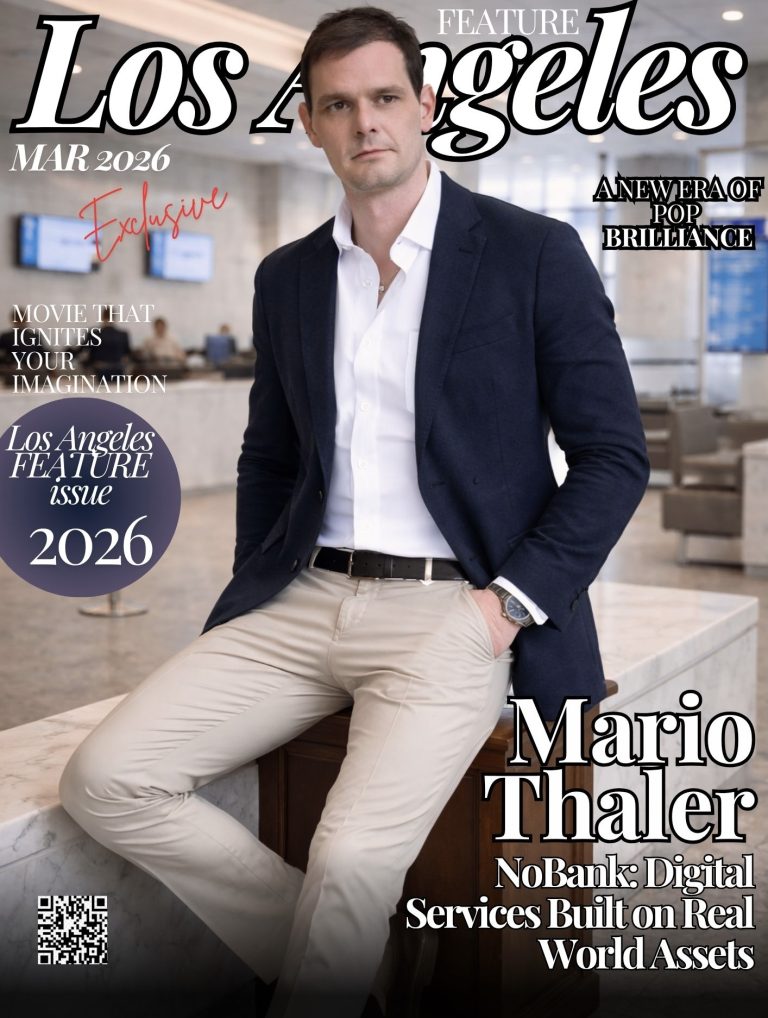
In an increasingly crowded digital finance landscape, NoBank (www.nobank.plus) positions itself with a clear and differentiated proposition: combining advanced financial services with a foundation rooted in tangible, real-world assets. Founded in 2023 and launched operationally in 2026, the institution is designed not simply as a fintech platform, but as a structured ecosystem where digital efficiency and asset-backed stability coexist.
At the center of this initiative is Mario Thaler, an Austrian entrepreneur with over two decades of experience in international corporate environments. His background in managing complex financial operations has directly influenced NoBank’s model, which prioritizes practical functionality, operational efficiency, and long-term reliability.
“NoBank is built around what users actually need speed, clarity, and above all, trust supported by real value,” Thaler states.
A Service-Driven Banking Model for Modern Users
NoBank’s architecture is designed to simplify and modernize financial operations for both individuals and businesses. The platform offers fast onboarding, streamlined account management, and a modular service structure that allows clients to adapt financial tools to their specific operational needs.
Rather than replicating traditional banking processes in digital form, NoBank rethinks service delivery entirely. Users can manage transactions, access digital wallets, and interact within a unified environment that connects companies, investors, and private clients. This ecosystem approach enables not only financial transactions, but also collaboration, co-investment, and shared opportunities.
Efficiency is a key differentiator: reduced friction, lower operational costs, and faster execution times are embedded into the platform’s design. At the same time, strict privacy standards ensure that users retain full control over their data.

Asset-Backed Infrastructure at the Core
What fundamentally distinguishes NoBank is the integration of real assets into its service offering. While many digital finance platforms operate independently of physical value, NoBank structures its ecosystem around verifiable, tangible assets.
A central component is its gold-backed digital coin. Each unit issued on the platform corresponds directly to a physical gold reserve, ensuring that digital liquidity is always supported by a concrete underlying asset. This mechanism reduces exposure to volatility and introduces a level of financial discipline often absent in purely digital systems.
The proprietary ledger supporting these transactions is designed for immutability and security. By maintaining full control over its technological infrastructure, NoBank ensures high performance standards, resistance to cyber threats, and complete traceability of asset-backed operations.
Investment Services Linked to the Real Economy
Beyond payments and digital wallets, NoBank extends its offering into investment services grounded in real economic activity. The platform provides access to opportunities that are directly tied to physical assets and measurable outputs.
These include:
• Land and agricultural projects, offering exposure to productive and income-generating resources
• Real estate developments, enabling participation in tangible, monitorable assets
• Partnerships with verified operators, ensuring that all activities are linked to real businesses rather than speculative digital constructs
This approach allows users to engage with investment opportunities that combine transparency, traceability, and intrinsic value—key elements often lacking in purely digital financial environments.
Security, Privacy, and Trust as Operational Foundations
In a sector where trust remains a critical challenge, NoBank integrates security and privacy as core components of its service model. Data protection is embedded at the architectural level, while transparency mechanisms ensure that users can verify how their assets and information are managed.
A Hybrid Model for the Future of Finance
NoBank represents a hybrid approach to financial services: combining the accessibility and speed of digital platforms with the stability of real-world assets. Its service offering goes beyond traditional banking by integrating payments, asset-backed instruments, and investment opportunities within a single ecosystem.
By aligning digital innovation with tangible value, NoBank provides a structured alternative to both conventional banking systems and highly speculative digital platforms. The result is a model focused not only on technological advancement, but on sustainable, asset-driven financial growth.
As digital finance continues to evolve, NoBank’s strategy highlights a broader shift in the industry—one where services are no longer separated from underlying value, but instead built directly upon it.
Interview – NoBank and the Future of Digital Finance
Journalist: In such a competitive fintech landscape, what core problem are you aiming to solve?
Mario Thaler: We are addressing structural inefficiencies that have persisted in the European banking system for decades—slow execution layers, high intermediation costs, and rigid infrastructures that are not designed for today’s digital economy. Most institutions have attempted to digitize legacy systems rather than rethink them. NoBank takes a different approach: we rebuild the financial stack from the ground up, focusing on speed, cost-efficiency, and adaptability, while maintaining the robustness expected from financial institutions.
Journalist: Your approach seems different from many fintech players. How so?
Mario Thaler: A large portion of fintech innovation has focused on user experience and front-end digitization, but often without addressing the underlying economic substance. Many platforms operate in a purely digital environment, detached from real-world value creation. Our model integrates digital infrastructure with tangible assets, which introduces an additional layer of discipline. This reduces exposure to volatility and aligns financial activity more closely with real economic fundamentals.
Journalist: Do you believe the fintech sector has become too speculative?
Mario Thaler: In several areas, yes. There has been a tendency to prioritize rapid innovation and growth over sustainability and resilience. This has led to models that scale quickly but lack structural integrity. We take a more conservative view in that sense: innovation is meaningful only if it can endure stress scenarios and maintain trust over time. Anchoring digital finance to real assets is one way to ensure that stability.
Journalist: Your gold-backed coin reflects that philosophy. What is its key advantage?
Mario Thaler: The primary advantage is the direct link between digital liquidity and physical value. Gold has historically been a store of value across economic cycles, and by tokenizing it, we make it accessible, divisible, and transferable in a modern financial environment. This approach reduces counterparty risk and mitigates the extreme volatility often associated with unbacked digital assets. It essentially bridges the gap between traditional wealth preservation and digital usability.
Journalist: Can a model tied to physical assets scale effectively?
Mario Thaler: Scalability is often misunderstood as purely exponential growth. In our view, sustainable scalability is about controlled expansion supported by real capacity. We rely on modular operational structures and established supply chains for sourcing and managing assets. This ensures that every unit of growth is backed and verifiable. It may not produce artificial hyper-growth, but it creates a far more resilient system.
Journalist: Why did you choose to develop proprietary technology?
Mario Thaler: Because our model does not fit neatly into existing technological frameworks. Standard solutions are optimized either for fully digital assets or for traditional financial systems, but not for a hybrid of both. By developing our own ledger, we can tailor security protocols, transaction validation mechanisms, and performance parameters specifically to our needs. This level of control is essential to guarantee immutability, cybersecurity resilience, and operational efficiency.
Journalist: How would you define NoBank today—a bank, a platform, or something else?
Mario Thaler: It is more accurate to describe NoBank as an ecosystem. We are not limited to providing financial products; we facilitate interactions between different economic actors—companies seeking capital, investors looking for stability, and individuals managing wealth. By structuring these interactions within a single environment, we enable value creation that goes beyond traditional transactional banking.
Journalist: Is a community-driven model truly scalable?
Mario Thaler: It is, provided that the community is built around aligned incentives and real value exchange. Many platforms use the term “community” loosely, but without meaningful economic interaction, it remains superficial. Our focus is on creating a network where participants contribute and benefit in measurable ways.
Journalist: How do you address trust and privacy concerns?
Mario Thaler: Trust is the foundation of any financial system. We approach privacy and data protection not only from a regulatory standpoint but as a core component of our value proposition. Users need to understand how their data is handled and feel confident that it is secure. At the same time, transparency must be preserved to ensure accountability. Balancing these two elements is critical, and we have embedded both principles into our architecture from the outset.
Journalist: Are you competing more with traditional banks or crypto platforms?
Mario Thaler: We are effectively positioning ourselves between the two. Traditional banks offer stability but often lack speed and innovation, while many crypto platforms provide innovation but struggle with volatility and trust. Our objective is to combine the strengths of both models—leveraging technological efficiency while maintaining a foundation in real-world assets.
Journalist: What is your vision for the next few years?
Mario Thaler: Our goal is to establish a new benchmark for digital finance—one that is not defined by speculation or legacy constraints, but by sustainability, transparency, and real value. If we execute effectively, NoBank can move from being perceived as an alternative model to becoming a mainstream solution for individuals and institutions seeking a more balanced approach to finance.